






 Back to blog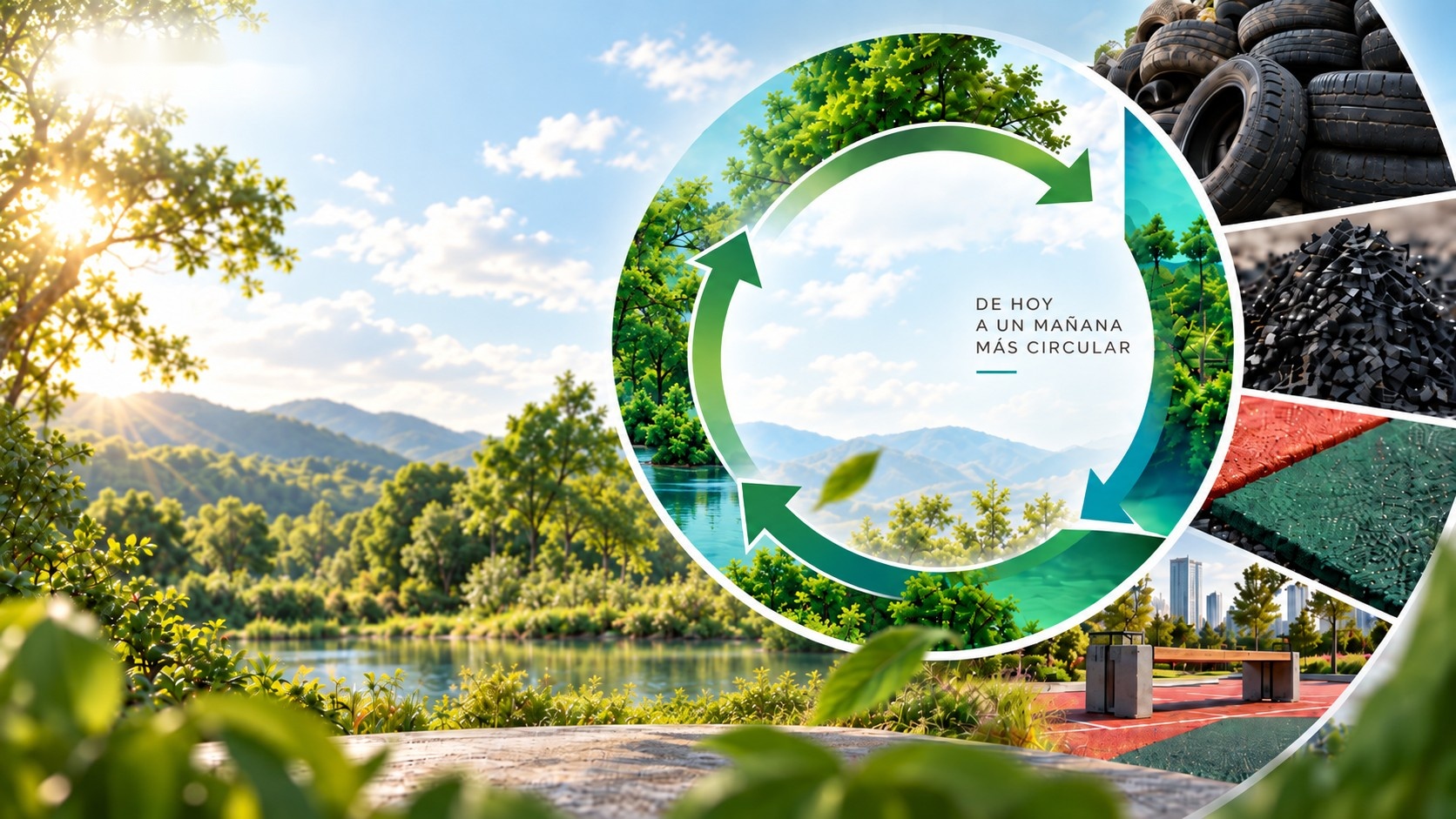
By Lizza Gallardo Santander ·
Sustainability and circular economy: XBRI's environmental commitment
Learn about XBRI's actions to promote sustainability, the responsible management of end-of-life tires and the circular economy together with specialized partners.
Giving more life to every resource is also part of moving forward
At XBRI we understand sustainability as a commitment that accompanies the tire throughout its entire life cycle. From the search for resistant, efficient and durable products to the responsible management of those that reach the end of their use, every stage represents an opportunity to make better use of resources and reduce our impact on the environment.
That is why our vision does not end when a tire stops rolling.
We work so that End-of-Life Tires (ELTs) can be incorporated back into a production chain, turning from waste into a resource with new possibilities.
What happens to a tire when it is no longer used?
End-of-life tires need proper management.
Their accumulation or incorrect disposal is not only an environmental challenge, but can affect the cleanliness and safety of farmland, cities and communities.
That is why XBRI works alongside specialized companies, promoting responsible and traceable management of ELTs. This partnership makes it possible to recover materials from tires that have already served their purpose and return them to new production chains.
The process begins with receiving and cutting the tire, followed by shredding. Different granulation and separation stages are then carried out, recovering components such as rubber, steel and textile fiber until materials are ready for new uses.
This way, a product that reached the end of its service life can become raw material once again.
From end-of-life tires to new resources
The rubber recovered from ELTs can return to society transformed into rubber flooring, sports surfaces, urban solutions and various industrial products.
So what could once be considered simply waste begins a new cycle.
More than 1,300 tons destined for recycling
A commitment to sustainability needs to translate into measurable results.
Between 2023 and 2025, the management carried out made it possible to send more than 1,300 tons of end-of-life tires to recycling.
The records show more than 320 tons in 2023, 512 tons in 2024 and 509 tons in 2025, avoiding their improper disposal and allowing their transformation into new resources.
The impact of this management reaches:
- 1,300 tons of ELTs processed and 136,624 tires managed.
- 2,444 tons of CO₂ equivalent mitigated.
- An impact presented as equivalent to 122,200 trees.
And the work continues. During the first half of 2026, the report records another 60 tons of ELTs destined for recycling, giving continuity to the process started in previous years.
Our commitment to the Sustainable Development Goals
The actions developed by XBRI together with its partners are also related to various United Nations Sustainable Development Goals (SDGs), especially:
- SDG 3 – Good Health and Well-Being, through actions that foster cleaner and safer environments.
- SDG 11 – Sustainable Cities and Communities, promoting adequate waste management.
- SDG 12 – Responsible Consumption and Production, recovering materials and reincorporating them into new production cycles.
- SDG 13 – Climate Action, through actions associated with reducing environmental impact and making the most of resources.
- SDG 17 – Partnerships for the Goals, because moving toward a circular economy requires cooperation between companies, specialized operators and different actors in society.
That is the circular economy principle we want to keep advancing: turning commitments into actions and waste into new resources.