 Español
 Português
 English
 My account
 My orders
 Your wishlist
 Your cart
Suspension geometry and tire wear
How do you identify tire wear caused by incorrect suspension angles, and why aren't these angles always straight?
There are three main suspension angles that can cause irregular tire wear and directly affect the vehicle's handling:

Toe-in or Toe-out

Camber

Caster
Static vs. dynamic
First, let's understand how these angles affect the vehicle's behavior. It's important to understand that alignment adjustments are always made statically (with every component at rest) so that, dynamically (with the vehicle moving), they behave the way the vehicle's engineering intended. That's why, before doing an alignment, you need to check the recommended angles listed in each vehicle's owner's manual.
Toe-in or Toe-out
When the wheels point toward each other's path of travel, they're said to be toeing in. When they point away from each other, they're toeing out.
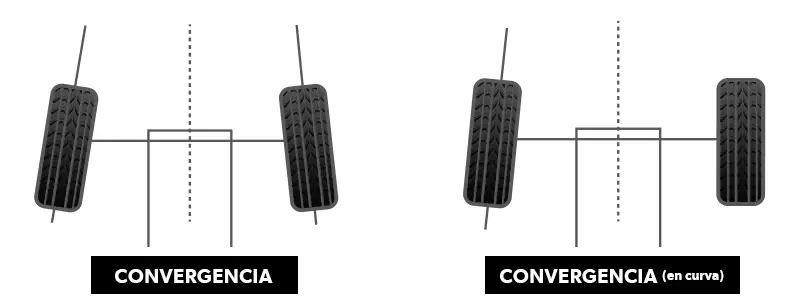
Toe-in
A toe-in alignment gives the vehicle stability in a straight line: the wheel on the side the vehicle is being steered toward stays straight, and only afterward does the vehicle start turning, so the motion is slower and absorbs bumps or small movements without pulling the vehicle off its path.
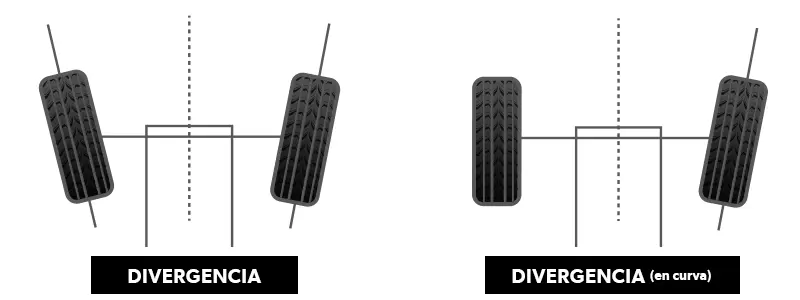
Toe-out
A toe-out alignment gives more agility entering curves, precisely because it behaves the opposite way from toe-in: the inside wheel is already pointing into the curve, giving a faster response to the steering wheel's movement.
Camber
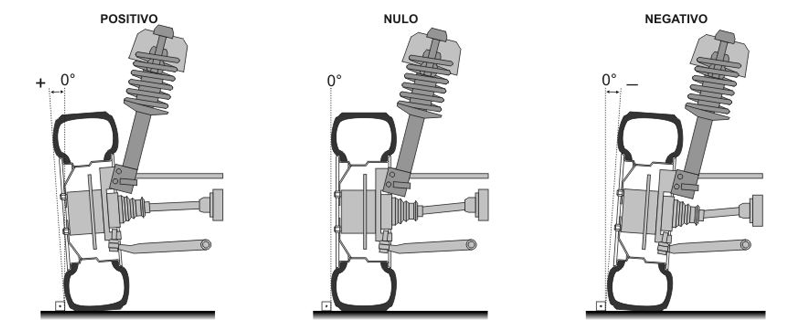
Camber is the angle of the wheel's vertical axis relative to the ground. It's set to get the best contact area between the tire's tread and the ground, based on the suspension's movement and the body's roll. It can be negative, tilting in curves so the tread on the outer side of the curve (the contact point) sits fully flat on the ground.
That said, the setting is ultimately decided by the manufacturer based on what the vehicle is built for — a sports vehicle with more lateral load in curves, or an urban vehicle that needs little suspension work in curves and prioritizes fuel economy.
Caster
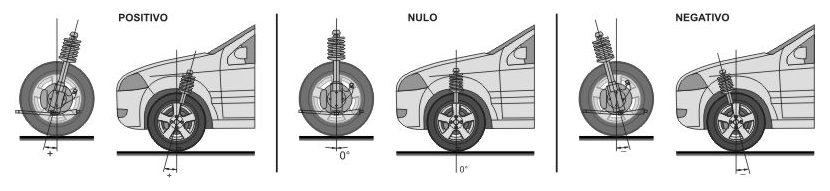
This is the tilt of the imaginary vertical line drawn between the steering axis's pivot points, viewed from the side of the vehicle. If the bottom of that line sits ahead of the top, caster is positive; if it sits behind, caster is negative.
The closer it is to positive, the more the wheel tends to hold a straight line, increasing stability under those conditions — but it also takes more effort to steer. That's why this factor matters: a vehicle may use different caster settings depending on whether it has hydraulic or mechanical steering.
Types of Wear
Now that you know the main steering angles and how they affect the vehicle's behavior, here's how to identify which one may be off the manufacturer's spec through irregular tire wear.

Remember: every time you change tires or suspension components, and at least every 6 months or 10,000 km, the alignment should be checked, to avoid premature wear on tires and suspension parts, avoid affecting fuel consumption, and keep the vehicle handling as intended.
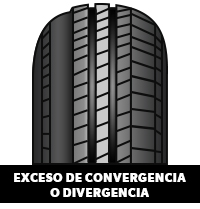
Wear from excess toe-in or toe-out
Wear from excess toe-in or toe-out happens on the outer edges of the tread, because the tire keeps moving sideways.
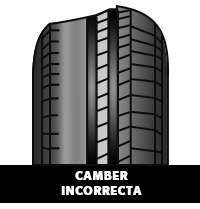
Wear from incorrect camber
Causes wear that deforms the tread, tilting the area where it makes contact.
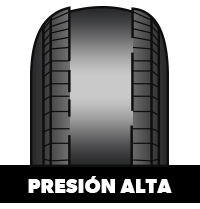
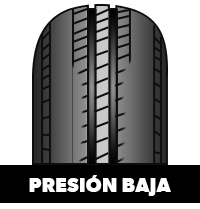
Wear from incorrect inflation
With incorrect tire inflation, wear happens at the center of the tread when pressure is above the manufacturer's recommendation, and on the edges when it's below.